
By the time you start looking at invitations, the big decisions are usually already in motion — the date, the hall, her saree, the relatives you cannot celebrate without. The invitation is the first of those decisions your guests actually see, and it tends to be the one families make last and fastest.
It deserves a little longer than that. A Half Saree Ceremony has its own visual language, and a design drawn for this occasion carries it in a way a general-purpose template never quite manages. Here is what to look at before you choose.
Know What the Motifs Mean
Traditional designs for this ceremony draw on a small, consistent vocabulary. Knowing what each element refers to makes choosing between them far easier. Significance varies by family, community, and region, so treat these as common readings rather than rules.
Temple borders and gopuram arches place the celebration in a devotional setting and suit a ceremony where the rituals are the centre of the day. The peacock carries associations of grace and, across much of South India, of the coming rains — a fitting image for a ceremony about a new season in her life. Kolam patterns echo the threshold drawing that marks a house as ready to receive guests, which makes them a quietly appropriate border for an invitation. Lamps, and the kuthuvilakku in particular, stand for the presence being invoked and read as unmistakably traditional even in a minimal layout. Jasmine and mango leaves are auspicious in their own right and appear in almost every version of the celebration.
If your family's ceremony leans devotional, the temple and lamp motifs will feel right. If it leans celebratory, peacocks, florals, and kolam borders carry the same tradition more lightly.
Match the Invitation to Her Saree, Not the Hall
Decor can be adjusted until the week of the event. Her saree is the fixed point, and it appears in every photograph you will keep.
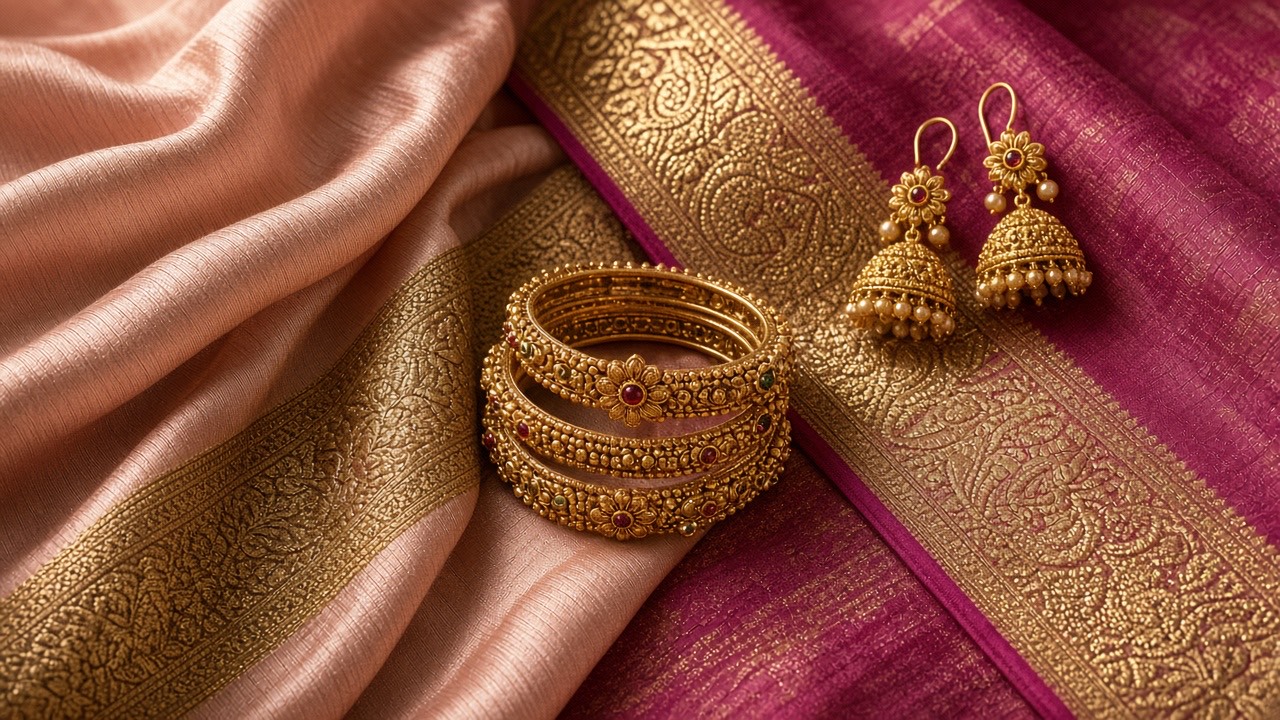
If she is wearing a traditional Kanjeevaram in maroon and gold, an invitation in that register looks deliberate. If her saree is a softer pastel or a contemporary weave, a heavily gilded design will read as a different event entirely. Guests won't consciously compare the two, but the photographs will.
You don't need an exact match — one shared colour is enough to make the invitation and the celebration feel like the same occasion. If you haven't settled the palette yet, our themes and decor guide covers how to build one that holds up under banquet lighting.
Traditional, Contemporary, or Somewhere Between
Ornate is not the same as traditional. A dense gold border on all four edges reads as busy rather than reverent, and it crowds the only information your guests came for.
Contemporary layouts — more open space, one strong motif, restrained type — carry a traditional ceremony perfectly well. They also age better in an album, and they survive being resized.
The test is simple. Look at the design and notice what you read first. If it is her name, the design is working. If it is the border, the design is competing with her.
Remember Where It Will Be Seen
Almost every Half Saree Ceremony digital invitation is opened on a phone, and it is usually seen first as a WhatsApp thumbnail no wider than a thumb. A design that is beautiful at full size can be unreadable at that scale.
Fine script fonts, pale gold on ivory, and text set over a busy floral all lose their legibility when the image shrinks. Strong contrast between the text and whatever sits behind it survives. So does a clear hierarchy, where her name and the date are visibly larger than everything else.
Before you commit, view the design at thumbnail size and see whether you can still make out her name and the date. Elders will zoom in regardless, but a guest scrolling through a group chat decides in a second whether to open it.
If Your Family Calls It Something Else
Families name this day differently — Half Saree Function, Puberty Ceremony, Ritu Kala Samskara, or a regional name particular to your community.
The design rarely needs to change. A Puberty Function invitation and a Half Saree Ceremony invitation draw on the same visual tradition, because it is the same celebration. What changes is the wording, and that is the part you personalise: the heading, how the hosts are named, and any ritual detail your family includes. Our digital invitation guide covers what to include and how to phrase it.
A Few Checks Before You Commit
Look for her full name at full length. Names with a family or house prefix are longer than most templates anticipate, and a design that shrinks the name to fit has lost its focal point.
If you plan to set Tamil or Telugu alongside English, check that the layout leaves room for a second line without crowding — two scripts need more breathing space than one.
Ask whether the design comes as a set. A matching welcome sign carries the same artwork to the entrance, and it is far easier to arrange while you are choosing the invitation than after.
And if you are printing a handful of copies for elders who would rather hold one, confirm the file you receive is print-ready at the size you want, not only sized for a screen.
Then Make It Hers
Choosing well is most of the work. Once the design is decided, personalising the details and sharing it takes a few minutes, and the invitation and your guest list stay in the same place.
Ready to choose? Browse Half Saree Ceremony invitation designs and see how each one looks with her name on it.